
Nutrition Supplements
Dehydroacetic Acid
Dehydroacetic Acid - Cosmetic Ingredients
Request a Quick Quote →Product Overview
Product basic attributes
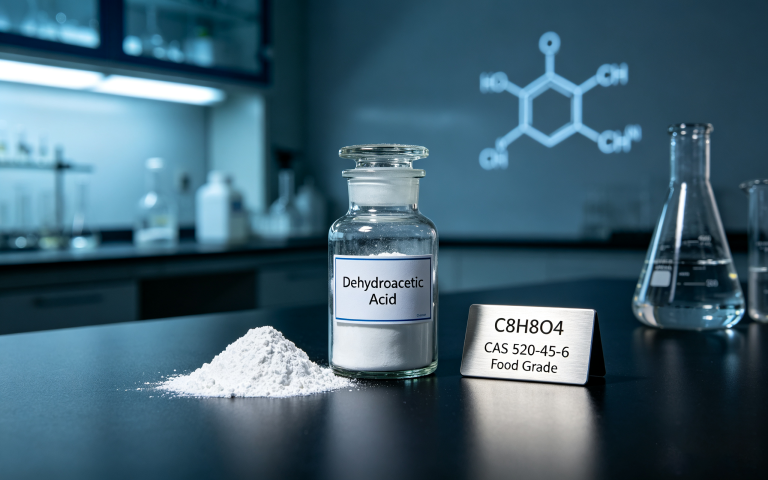
- English name: Dehydroacetic Acid, abbreviated as DHA, Chinese name: Dehydroacetic Acid
- CAS number: 520-45-6
- Molecular formula: C₈H₈O₄, Molecular weight: 168.15
- Appearance and properties: White to off-white crystalline powder, almost odorless
- Melting point: 109–113℃, Boiling point: approximately 270℃, Flash point: 157℃
- Solubility: Slightly soluble in cold water, soluble in organic solvents such as acetone, benzene, and hot ethanol, with low solubility in water
- Product characteristics: Broad-spectrum antibacterial, can inhibit bacteria, molds, and yeasts; Good stability, applicable in a wide pH range
Application fields
- Food industry: As a food preservative, it is used in pastries, pickles, beverages, baked goods, etc., to inhibit the growth of microorganisms and extend the shelf life of food.
- Cosmetics industry: A broad-spectrum preservative for cosmetics, used in face creams, cleansing products, lotions, essences and other skin care products, to prevent product mold and contamination.
- Cosmetics field: Preservative for daily care products such as toothpaste and shampoo, to inhibit microbial reproduction and stabilize the formulation system.
- Industrial field: Preservative for PVC plastics, coatings, resin products; organic synthesis intermediates.
Product Specifications
| Specification | Value |
|---|---|
| Product Name | Dehydroacetic Acid |
| Category | Nutrition Supplements |
| Grade | Food / Flavor Grade |
| Packaging | 1 kg / 5 kg / 25 kg drum |
| Shelf Life | 24 months |
| Documentation | COA, TDS, MSDS supplied with each shipment |
| Origin | China |
Why Choose Taima Bio
Taima Bio supplies specialty ingredients with defined chemical specifications, full documentation (COA, TDS, MSDS), and reliable international supply. Our products serve food, beverage, confectionery, and flavor formulation customers worldwide, with flexible quantities from laboratory evaluation to commercial-scale packaging.